
If you've spent any real stretch of your day with a toddler balanced on one hip, you already know the exact progression: a dull ache in the forearm first, then a tightness that creeps up into the shoulder, and by evening a low, stubborn soreness that sits somewhere between your shoulder blade and your lower back. It's not in your head, and it's not because you're unfit — it's basic biomechanics working against you.
Why hip-carrying is so hard on your body
When you carry a toddler on one hip without any support, three things happen at once. First, your forearm and bicep bear almost the entire load in a static, sustained contraction — the kind of muscle work that fatigues far faster than dynamic movement like walking or lifting. Second, to counterbalance the weight on one side, your spine curves laterally and your opposite hip drops slightly, a compensation pattern physiotherapists sometimes call "hip hike." Held for long enough, repeated daily, this asymmetric loading is a common contributor to lower back and sacroiliac joint discomfort in parents of toddlers. Third, your shoulder on the carrying side elevates and internally rotates to help stabilise your arm, which is why that dull ache so often migrates from your forearm up into your trapezius and neck by the end of the day.
None of this is dramatic on its own. A single carry doesn't hurt anyone. The problem is repetition — a toddler weighing anywhere from 10 to 16kg, picked up and carried a dozen or more times across a day, every day, for months. Cumulative strain injuries build exactly this way: not from one bad moment, but from thousands of small ones stacked on top of each other.
What's actually happening, muscle by muscle
The main muscles under strain during unsupported hip-carrying are the brachioradialis and biceps brachii in the forearm and upper arm, the upper trapezius and levator scapulae in the neck and shoulder, and the quadratus lumborum along the lower back — the muscle most responsible for that dropped-hip compensation pattern. None of these muscles are designed for sustained, one-sided static loads; they're built for movement, not for holding a fixed position under weight for minutes at a time.
Practical relief you can use today
- Alternate sides deliberately, not just when one arm gives out. Switching every few minutes, rather than waiting until you're already sore, prevents the cumulative load from concentrating on one side of your body.
- Bend at the knees, not the waist, when picking up. Hinging from your hips and knees keeps the lift's load on your legs and glutes — much stronger muscle groups — rather than your lower back.
- Actively engage your core when carrying, not just your arm. A braced abdomen helps stabilise your spine against the asymmetric load, reducing how much compensation your back has to do on its own.
- Do a daily 60-second shoulder and forearm stretch routine. Shoulder rolls, cross-body arm stretches, and wrist flexor stretches take under a minute and meaningfully reduce the tension that builds from repeated static holds.
- Address the root cause, not just the symptoms. Stretching and alternating sides help manage the strain — but they don't remove it. The only way to genuinely reduce the load is to change how the weight is distributed in the first place.
Why redistributing the load, not just enduring it, is the real fix
This is the actual mechanical difference a one-shoulder carrier makes: instead of your forearm and bicep bearing an isolated static load, the weight is transferred via a wide strap across your shoulder and diagonally across your back — engaging your larger, more fatigue-resistant back and shoulder muscles (the trapezius and latissimus dorsi) rather than the smaller, quicker-to-fatigue muscles of your forearm. It's the same principle behind why backpacks with proper straps feel dramatically lighter than the same weight carried in one hand — distribution across a larger muscle group changes how quickly fatigue sets in, not just how the weight feels in the moment.
The other advantage is speed. A structured carrier with multiple buckles and adjustment points can take a couple of minutes to put on correctly — which is exactly the amount of time you don't have during a two-minute meltdown at the school gate. A one-shoulder design with a single adjustable buckle and a safety loop can go from folded-in-a-bag to on-and-carrying in under ten seconds.
When this actually matters in a real day
The moments this solves aren't the planned outings — they're the unplanned ones. The grocery run where your toddler refuses the trolley seat. The school pickup where they want to be carried the entire walk home. The thirty seconds at the front door where you need one hand completely free for your keys while the other holds a squirming toddler who has decided walking is, for today, unacceptable.
Our toddler sling carrier was built around exactly this mechanical problem: a soft cotton, one-shoulder design engineered to move the load off your forearm and onto your shoulder and back, with an adjustable main buckle plus a secondary safety loop for extra security. It folds down small enough to live permanently in a nappy bag or car door pocket, so it's there for the moment you actually need it — not just the moments you planned for.
If your arm is already telling you it's had enough for the day, that's not something to push through indefinitely. It's a signal worth actually listening to — and worth solving properly, not just managing.
Ready to give your arms a break?
30% off automatically applied, plus a free Storage Pouch with your carrier.
Shop the Carrier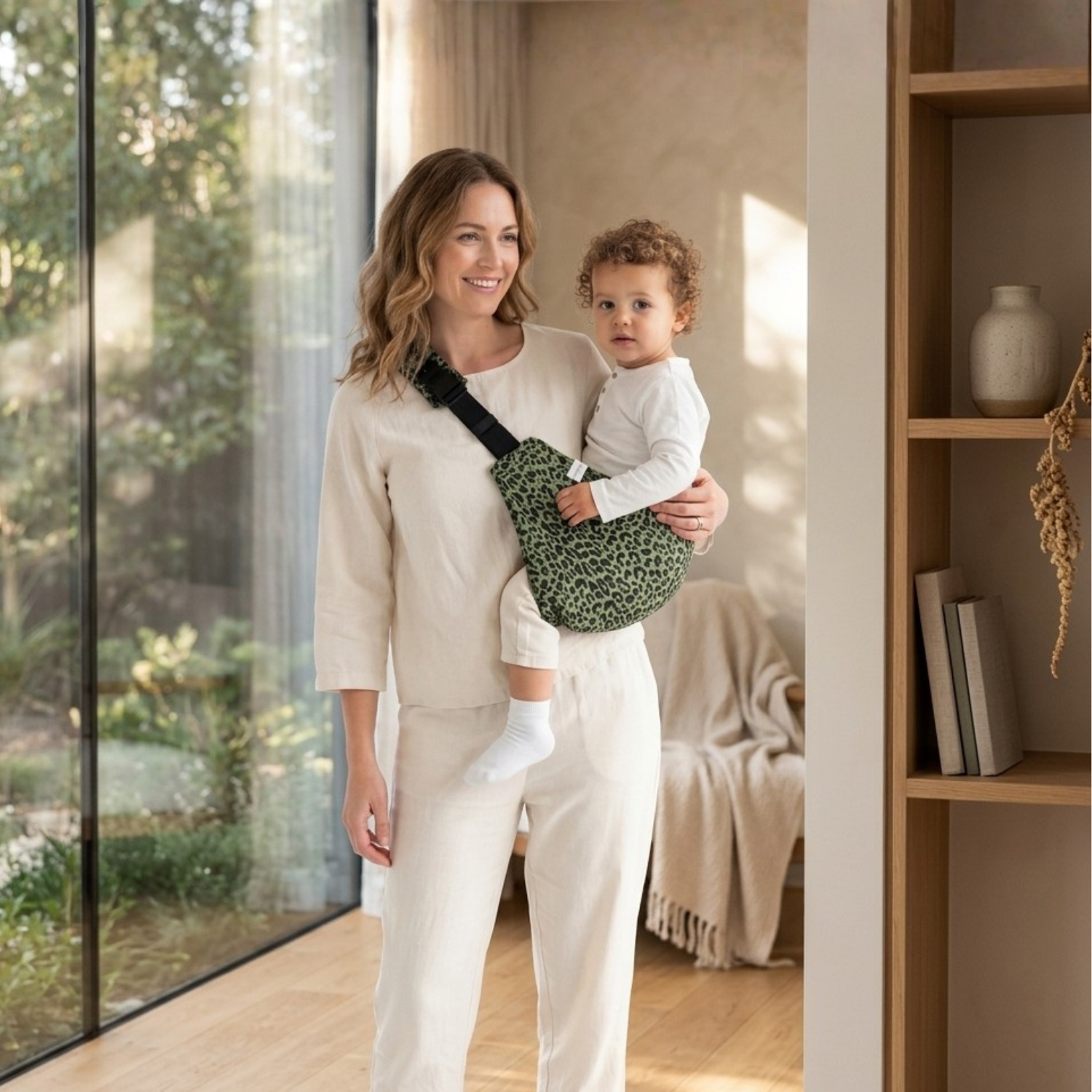
Leave a comment
This site is protected by hCaptcha and the hCaptcha Privacy Policy and Terms of Service apply.