
When more doesn’t always mean better
Before a baby arrives, it can feel like everything is essential.
Lists grow longer, recommendations multiply, and suddenly parenting appears closely tied to the things you own. Many parents later realise that while some items are helpful, the true heart of early parenthood lives elsewhere, in time, connection and presence.
Minimalist parenting isn’t about going without.
It’s about choosing with intention.
Shifting the focus from quantity to purpose
Minimalism in parenting begins with a simple question:
Does this support our life, or add to the noise?
Rather than accumulating solutions for every possible scenario, many families find comfort in selecting a few well-designed, versatile essentials that naturally fit their routine.
This shift often creates space, physically and emotionally for what matters most.
Creating calmer spaces at home
Babies don’t require elaborate environments to thrive.
Soft lighting, familiar voices, and responsive care are often far more meaningful than perfectly styled nurseries or overflowing toy baskets. When spaces are less crowded, they can feel more peaceful for both parent and baby.
A calm environment doesn’t need to be minimal for appearance.
It can be minimal for ease.
Reducing decision fatigue
One of the quieter benefits of minimalist parenting is fewer daily decisions.
When your home and routines revolve around a smaller number of trusted items, mornings can feel smoother, outings simpler, and transitions less overwhelming.
Energy that might have been spent managing things can instead be spent enjoying moments.
Choosing versatility over novelty
Thoughtful essentials often serve multiple purposes.
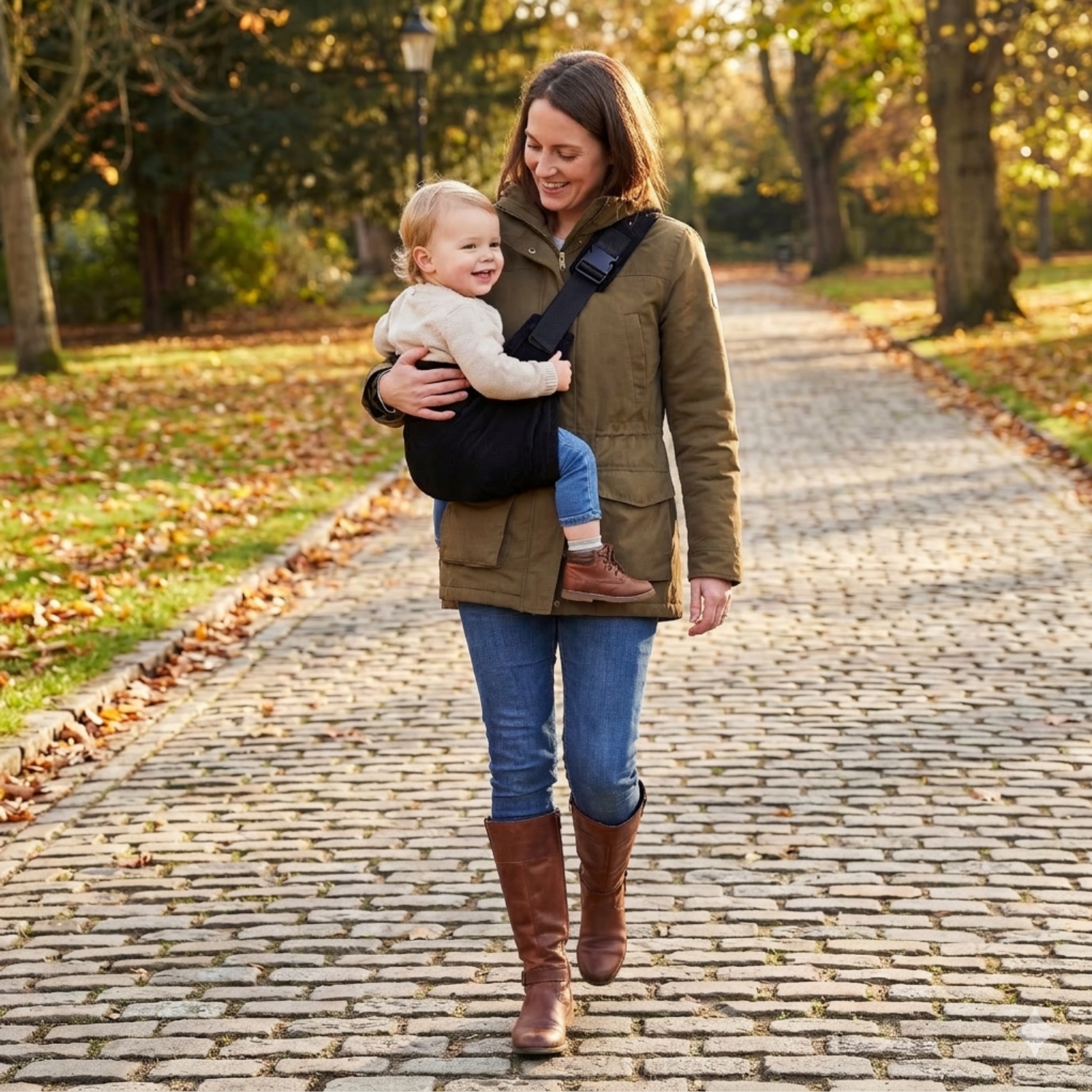
A well-loved blanket becomes comfort, play space and travel companion. A trusted carrier becomes a tool for walks, settling, errands and connection. Items chosen for their adaptability tend to remain part of daily life rather than fading into storage.
Minimalism values usefulness over novelty.
Making space for connection
Perhaps the most meaningful outcome of choosing less is the space it creates for relationship.
Without constant focus on managing belongings, many parents notice greater presence, more eye contact, slower walks, longer cuddles, and quieter pauses.
These experiences rarely require more things.
They often require less distraction.
Minimalism looks different for every family
There is no single version of minimalist parenting.
For some, it means fewer toys. For others, simplified routines, capsule wardrobes, or prioritizing multi-functional products. The intention remains consistent, to support family life rather than complicate it.
Your version will naturally reflect your values, home and rhythm.
A gentle approach to choosing well
Minimalist parenting is not about restriction or rules.
It’s about thoughtful consideration, selecting items that feel supportive, comfortable and aligned with how you want your days to unfold. Over time, these choices can create an environment where both parent and baby feel more at ease.
Because parenting isn’t measured by how much you have.
It’s often shaped by how you feel within what you have.
A quiet reminder
If you’re choosing carefully, noticing what works, and letting go of what doesn’t, you’re already practicing a form of minimalist parenting.
Not perfectly, but intentionally.
And in the early years, intention can be one of the most valuable things you carry forward.
One well-chosen essential: a carrier that actually gets used
30% off automatically applied, plus a free Storage Pouch with your carrier.
Shop the Carrier

Leave a comment
This site is protected by hCaptcha and the hCaptcha Privacy Policy and Terms of Service apply.