

When advice feels overwhelming
Early parenthood brings curiosity, instinct, and often, conflicting opinions.
Babywearing is one of those topics where reassurance and doubt can sit side by side. You may hear that holding your baby too often creates dependency, affects development, or becomes difficult to stop.
Yet many parents discover something different, that closeness simply feels right.
Let’s gently unpack a few common babywearing myths and the reality behind them.
Myth 1: “Holding your baby too much will spoil them”
Babies don’t yet have the ability to manipulate or form habits in the way older children do.
What they do have is a strong need for comfort, safety and regulation. Responding to that need through closeness helps them feel secure and understood.
Over time, this security often supports confidence and independence rather than preventing it.
Closeness isn’t spoiling it’s responding.
Myth 2: “Babies need to be put down to develop independence”
Independence grows gradually through secure attachment.
When babies feel safe and supported, they naturally begin exploring their surroundings as they develop. Being held or carried doesn’t delay this processm it often provides the reassurance that makes exploration feel safe.
Independence doesn’t begin with distance.
It often begins with connection.
Myth 3: “Babywearing will hurt your back”
Comfort depends largely on design and fit.
A thoughtfully designed carrier that distributes weight evenly can feel surprisingly supportive for everyday use. Many parents find that once adjusted correctly, babywearing feels easier than carrying their baby in arms alone.
Listening to your body and adjusting fit can make a meaningful difference.
Myth 4: “You’ll never be able to stop once you start”
Like many aspects of parenting, babywearing evolves naturally.
As babies grow, their needs change. Some phases involve more closeness, others less. Most families find babywearing becomes one of many tools they use rather than a permanent routine.
It’s not a commitment it’s an option.
Myth 5: “Babywearing is only for newborns”
While newborn closeness is often highlighted, many families continue babywearing well into toddlerhood.
Carrying can remain helpful during busy outings, tired moments, or times when reassurance is needed. The experience simply adapts as your baby grows.
Closeness doesn’t have a strict age limit.
Myth 6: “You have to do it perfectly”
Perhaps the most common misconception is that babywearing must look or feel perfect.
In reality, most parents learn through gentle trial and adjustment. What matters most is safe positioning, comfort, and finding a rhythm that works for you and your baby.
There is no ideal version to achieve, only your version to discover.
Finding reassurance in your instincts
Myths often appear where parenting intersects with emotion.
Babywearing is simply one way many parents respond to their baby’s need for connection while moving through everyday life. Some families babywear often, others occasionally, and some not at all.
What matters is not the method, but the relationship.
If closeness feels calming, comforting, or supportive for you and your baby, that experience is valid.
A gentle perspective
Parenthood rarely follows clear rules.
Instead, it unfolds through observation, adjustment and trust, in your baby, in your learning, and in yourself.
Babywearing doesn’t need to be defended or perfected. It can simply be another way to share closeness when it feels helpful.
And sometimes, that’s enough.
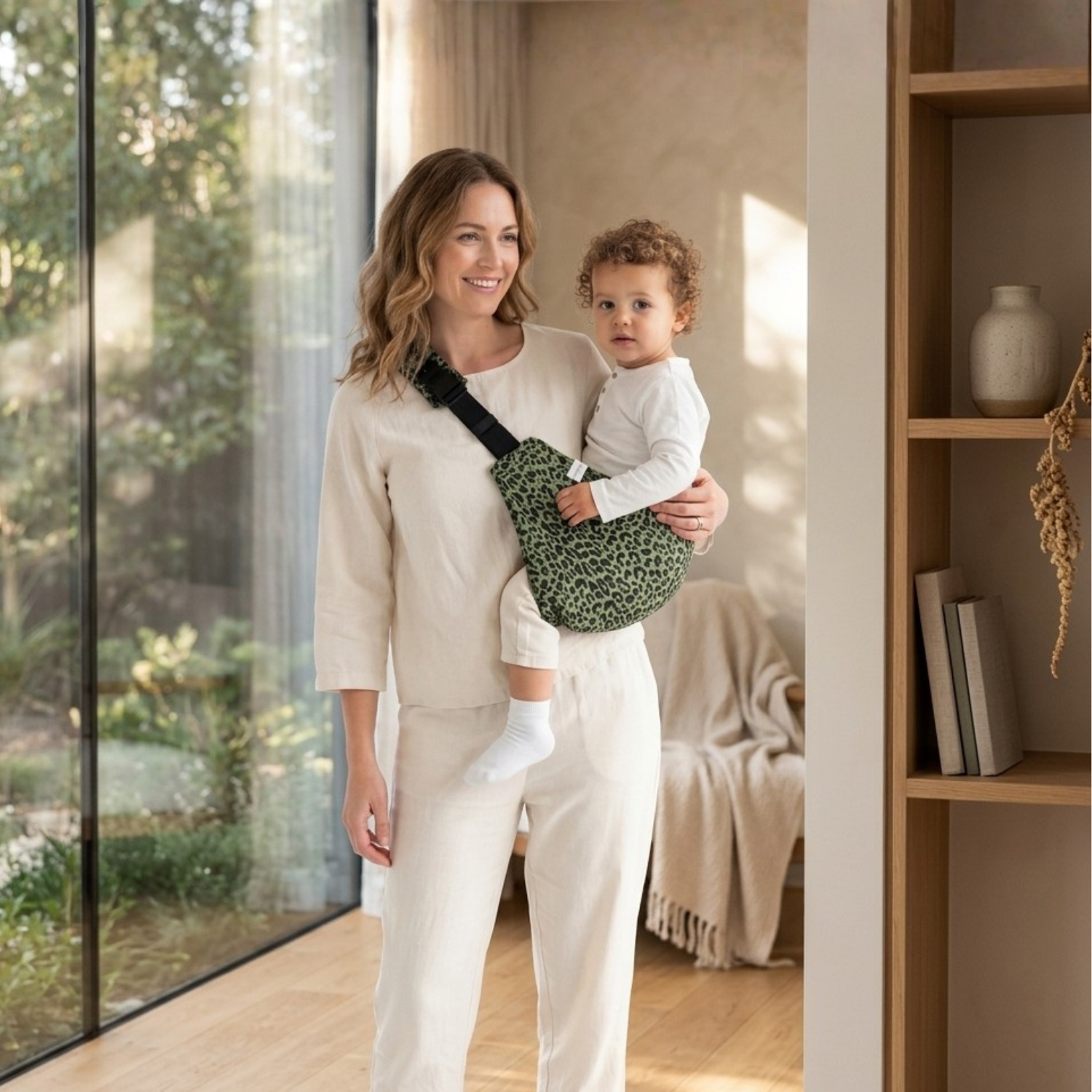
Curious about a one-shoulder carrier for the toddler stage?
30% off automatically applied, plus a free Storage Pouch with your carrier.
Shop the Carrier

Leave a comment
This site is protected by hCaptcha and the hCaptcha Privacy Policy and Terms of Service apply.